
California's Reading Renaissance: Lessons from Mississippi for Student Success
Imagine a scenario where a state, despite facing significant socioeconomic challenges, achieves remarkable gains in foundational literacy, while another, seemingly more affluent state, sees its students fall further behind.
This isn't a hypothetical; it's the current reality in reading instruction.
For parents and educators in California, understanding the factors behind Mississippi's surprising success offers a vital roadmap for elevating reading achievement for all students.
This article delves into the strategies that have propelled Mississippi forward and explores how California schools can implement similar, impactful changes.
The Divergent Paths of Reading Achievement: California vs.
Mississippi
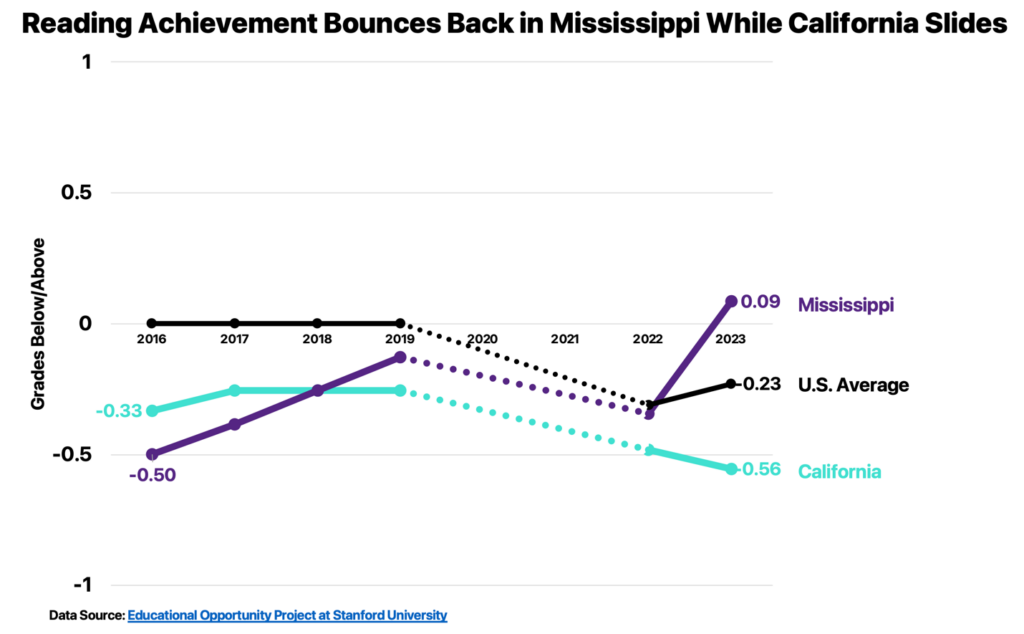
Recent educational data reveals a stark contrast in reading progress between California and Mississippi.
While Mississippi has emerged as a beacon of improvement, with its students now reading above national averages, California's reading scores continue a downward trend.
This divergence is not a recent phenomenon but rather the result of a decade of focused effort in one state and a lack of consistent, statewide commitment in the other.
The implications for students are profound, with a growing gap in foundational reading skills between similar students in the two states.
Studies indicate that prior to the pandemic, Mississippi students were already behind their California counterparts and the national average.
However, while both states experienced learning losses during the global health crisis, their recovery trajectories have been dramatically different.
Mississippi's commitment to a comprehensive reading strategy has yielded significant gains, positioning its schools as leaders in early literacy.
This success story is particularly noteworthy given Mississippi's higher child poverty rates compared to California, underscoring that achievement is driven by policy and practice, not solely by economic advantage.
Mississippi's Blueprint for Reading Success: Key Pillars
Mississippi's remarkable turnaround in reading instruction can be attributed to a deliberate and sustained focus on three critical areas: a unified vision, a curriculum-centric approach, and robust teacher professional development.
These pillars, when implemented with conviction, have created a powerful engine for literacy growth.
Pillar 1: A Unified State Mission for Reading Excellence
A cornerstone of Mississippi's success is the clear and consistent articulation of a statewide mission to improve reading achievement.
This vision has been championed by leaders across the state, from the governor's office to local school districts.
A decade ago, Mississippi's leadership established ambitious reading improvement goals, recognizing the profound impact of literacy on a student's entire educational journey and future life outcomes.
Research shows that when leaders prioritize reading, it sends a clear message throughout the educational system.
For instance, a former Mississippi governor famously linked aggressive intervention for dyslexia to a significant decrease in dropout rates and a turnaround in reading scores.
In contrast, while California's current governor has acknowledged his own dyslexia and the state has introduced new screening tools, a cohesive, overarching goal for reading improvement has been less evident in statewide addresses and policy discussions.
This absence of a unified mission can lead to fragmented efforts and a lack of sustained momentum for reading reform across California schools.
Pillar 2: Centering Curriculum on High-Quality Reading Instruction
Mississippi has placed a deliberate emphasis on selecting and implementing high-quality reading curricula.
Unlike California, where textbook adoption lists may not be consistently followed or tracked, Mississippi's approved list features materials that are rigorously vetted for alignment with college and career-ready standards.
This ensures that the instructional materials used in classrooms are research-based and designed to build deep comprehension and knowledge.
One highly regarded curriculum adopted in Mississippi is known for its ability to engage students with diverse texts, including fiction and non-fiction that explore a wide range of perspectives and topics.
This approach moves beyond rote memorization, fostering a love for reading and a richer understanding of the world.
California, on the other hand, has had less frequent textbook adoptions, and districts are not always mandated to use the state's recommended lists.
Studies indicate that some popular curricula used in California schools have been found to be poorly rated and negatively correlated with student achievement, highlighting a critical need for a more standardized and evidence-based approach to curriculum selection across the state.
The availability of high-quality, openly accessible curricula, such as those offered by publishers like Bookworms and EL Education, presents a significant opportunity.
These resources can reduce costs for districts and free up valuable funds to invest in teacher training and support, further enhancing the implementation of effective reading instruction in California schools.
Pillar 3: Strengthening Teacher Expertise and Professional Development
Mississippi's commitment to improving reading outcomes extends to its investment in teachers.
The state strategically deployed literacy coaches to its lowest-performing schools, providing direct support to educators in implementing new curricula and refining their instructional practices.
This targeted approach ensures that teachers receive the guidance and feedback necessary to translate research-based strategies into effective classroom instruction.
While California has also introduced literacy coaches, their reach has been limited, impacting a much smaller percentage of schools compared to Mississippi's scaled implementation.
This difference in scale can significantly impact the widespread adoption and effectiveness of new instructional methods.
Furthermore, Mississippi has taken a proactive stance in reforming its teacher preparation programs.
By mandating common coursework for all aspiring early literacy teachers, the state ensures that new educators enter the profession with a foundational understanding of scientifically based reading instruction.
Research indicates that a significant majority of Mississippi's teacher colleges now receive high ratings for their comprehensive literacy coursework, a stark contrast to the concerning percentage of California university programs that fail to address key components of effective reading instruction.
The autonomy historically enjoyed by university teacher preparation programs, while intended to foster academic freedom, has at times resulted in a lack of consistent, high-quality instruction in essential literacy skills for future teachers.
California's recent steps, such as the development of a new PK-3 teaching credential and a performance-based licensure test, are positive developments.
However, a more robust system of oversight is needed to ensure that all aspiring teachers in California are equipped with the expertise necessary to teach reading effectively.
Addressing Concerns: The Role of Third-Grade Promotion Gates
Some critics dismiss Mississippi's reading gains by pointing to the state's third-grade promotion gate, a policy that requires students to meet a certain reading proficiency level to advance.
However, this policy is not simply about retention; it is intrinsically linked to a robust system of support for struggling learners.
Students who do not meet the promotion threshold in Mississippi are not simply sent back to repeat the same grade.
Instead, they receive intensive, individualized reading instruction, often an additional 90 minutes per day, along with a personalized learning plan.
Crucially, they are guaranteed access to a high-quality teacher.
Studies from institutions like Boston University have shown that students who repeat third grade under such supportive conditions often demonstrate higher reading scores by sixth grade than their peers who narrowly passed the initial assessment.
This approach highlights that accountability measures, when coupled with targeted interventions and high-quality instruction, can be powerful drivers of student success.
California's Path Forward: Embracing Evidence-Based Reading Instruction
The data from Mississippi offers a compelling case for California to re-evaluate its approach to reading instruction.
Proposed legislation, such as Assembly Bill 2222, represents a significant opportunity to align California's practices with research-based methods.
This bill aims to establish a new textbook cycle that prioritizes scientifically proven reading strategies and mandates comprehensive training for current teachers, specialists, and literacy coaches.
Furthermore, the bill's focus on strengthening accountability for teacher preparation programs, drawing inspiration from states like Colorado, is crucial.
By holding universities accountable for equipping future educators with effective reading instruction techniques, California can ensure that all students, regardless of their background or location, have access to expert teachers.
The debate around local control versus statewide mandates is understandable, but the current reality for many California students, with only 43% of third graders reading proficiently, suggests that a more centralized and evidence-driven approach is necessary.
The responsibility for ensuring educational equity and excellence ultimately rests with the state.
By adopting a unified mission, prioritizing high-quality, research-aligned curricula, and investing in robust teacher professional development, California can learn from Mississippi's success and create a brighter future for its students.
The time for decisive action in reading instruction is now, ensuring that every child in every school has the opportunity to become a proficient reader.
Conclusion: Building a Foundation for Lifelong Learning
The contrasting trajectories of reading achievement in California and Mississippi offer invaluable lessons for educators and policymakers.
Mississippi's success demonstrates that with a clear vision, a commitment to evidence-based curricula, and a focus on empowering teachers, significant gains in literacy are achievable, even in the face of socioeconomic challenges.
For California, the path forward involves embracing these proven strategies, fostering a statewide commitment to reading excellence, and ensuring that all students receive the high-quality instruction they deserve.
By prioritizing foundational reading skills, California can build a stronger educational future for generations to come.






 Explore AI Teaching Tools
Comments (0)
Please login to comment
No comments yet
Be the first to comment on this article