
California's Education Budget: Billions Flow to Schools, But a $3.9 Billion Question Looms
California's Governor Gavin Newsom has unveiled a revised state budget proposal that injects billions of dollars into the state's K-12 and community college systems, addressing long-standing demands for increased funding. However, a significant portion of the anticipated revenue remains unallocated, sparking debate and concern among education advocates.
A Generous Pour, With a Catch
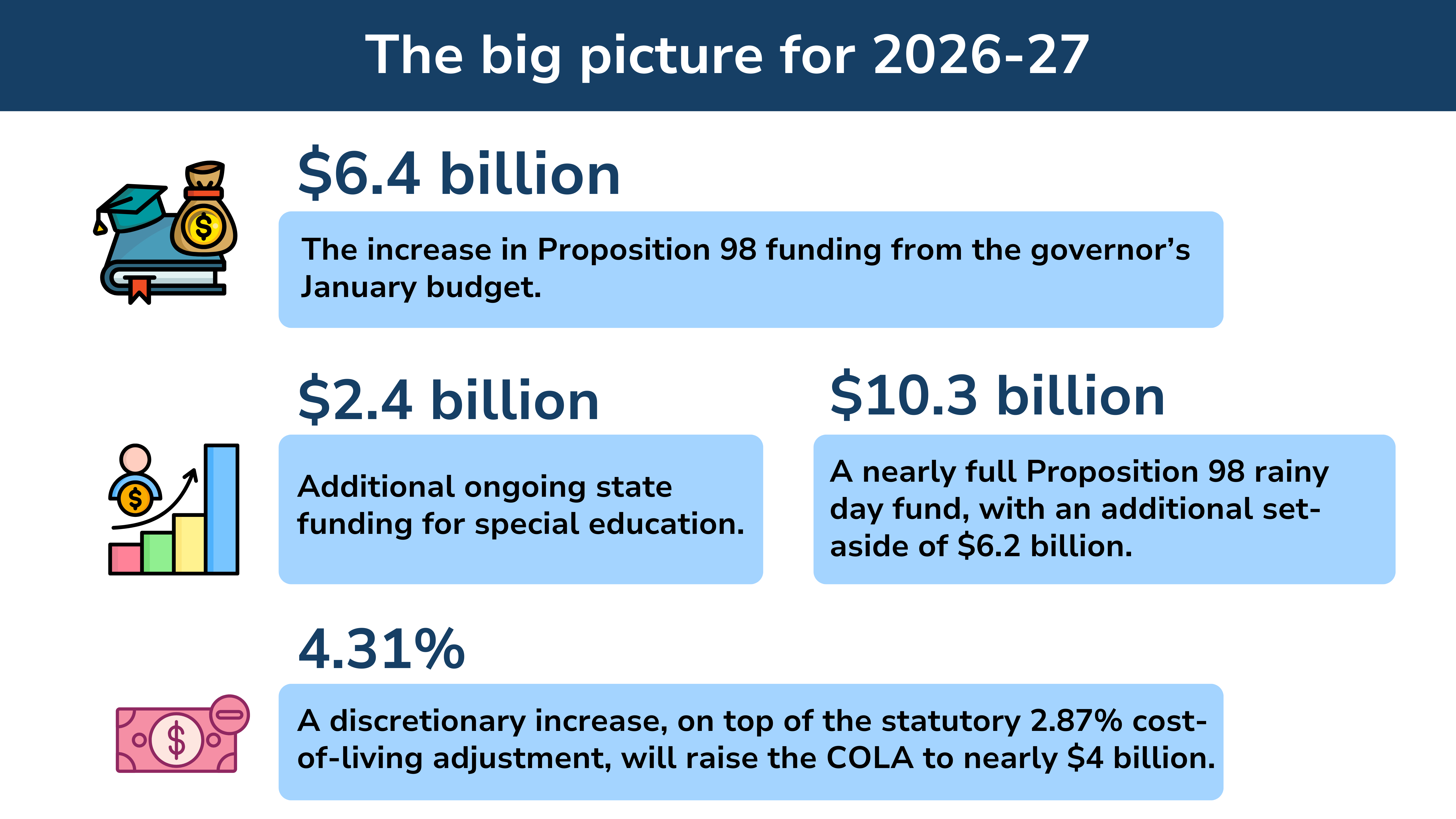
The Governor's May revision signals a substantial commitment to public education, with an additional $8.1 billion earmarked for schools and colleges compared to his initial January proposal. This influx of funds aims to bolster critical areas identified by school districts as facing significant financial strain.
Key priorities receiving a boost include a higher cost-of-living adjustment (COLA) for operating expenses, increased funding for special education services, and a substantial one-time discretionary block grant for schools. These allocations reflect a recognition of the rising costs districts face and the growing needs of students.
Furthermore, the budget proposes a new entitlement for all community college and K-12 employees: up to 14 weeks of paid pregnancy disability leave starting in the 2026-27 academic year. This benefit is intended to be covered by the increased COLA.
Despite these significant investments, a central point of contention persists. Governor Newsom is holding back $3.9 billion in Proposition 98 funding, a voter-approved guarantee for K-12 and community colleges. Education organizations argue this money should be immediately distributed to schools and colleges.
Addressing Core Needs: COLA and Special Education
Boosting Operating Funds with a Higher COLA
School districts have consistently voiced concerns about their base funding failing to keep pace with escalating operational costs, particularly in areas like special education and in light of declining enrollment trends. The Governor's proposal to increase the statutory minimum COLA from 2.87% to 4.31% directly addresses this issue.
This enhanced COLA, which will be applied through the Local Control Funding Formula, is projected to increase the allocation for districts' operating expenses from $3.1 billion to $4 billion. Crucially, this higher rate is set to become the new baseline for future COLA calculations, offering greater predictability for school budgets.
A Historic Investment in Special Education
The needs of students with disabilities have long been a significant concern, with state and federal funding often falling short of districts' obligations. Governor Newsom's revised budget proposes a substantial increase for special education, adding $1.8 billion to an initial $509 million increase, bringing the total to $2.4 billion.
This represents a 43% increase compared to the previous year and is being hailed as potentially the largest investment in special education in California's history, and perhaps even in American history. The Governor acknowledged the anxiety surrounding this area, stating that the administration has heard the demands from parents and is responding.
Discretionary Funds and Future Planning
A Generous Block Grant for Local Control
In a move designed to provide districts with flexibility, the Governor has significantly increased the proposed one-time discretionary block grant. Initially set at $2.8 billion in January, this grant has been raised to $5 billion. Dubbed the Student Support and Professional Development Block Grant, it is intended to support teacher training in critical areas like math and literacy, English learner support, career pathways, and dual enrollment programs.
However, the administration also implies that districts will have considerable latitude in how they utilize these funds, offering a degree of local control over spending priorities. This flexibility is seen as a positive step by many in the education sector.
Bolstering Reserves Amidst Uncertainty
Recognizing the potential for economic fluctuations, Governor Newsom's budget includes a plan to raise the Proposition 98 reserve fund to $10.3 billion. This substantial reserve approaches the statutory maximum and is intended to serve as a crucial buffer against potential recessions or unforeseen drops in projected tax revenues, particularly those linked to emerging industries.
This precautionary measure aims to ensure financial stability for the state's education system, even in the face of economic headwinds. The strategy acknowledges the volatile nature of revenue projections and prioritizes a secure financial foundation.
The Lingering Shadow of Withheld Funds
The most significant point of contention in the revised budget is Governor Newsom's decision to withhold $3.9 billion in Proposition 98 funding. This amount is part of a larger sum that was initially slated to be held back until early 2027, pending confirmation of state revenue projections.
Education organizations, including the California Teachers Association and the California School Boards Association, have strongly objected to this withholding. They argue that these funds are constitutionally guaranteed to schools and community colleges and should be allocated now to address immediate needs.
Representatives from these groups have expressed deep frustration, warning that the continued withholding of these funds will lead to overcrowded, under-resourced, and destabilized classrooms. Concerns have been raised about potential teacher layoffs and the jeopardizing of vital educational resources.
Governor Newsom, when questioned about the issue, urged education advocates to consider the broader fiscal picture. He highlighted the administration's significant and historic investments in transforming the K-12 education system, emphasizing unprecedented per-pupil spending that he believes is the envy of many other states.
Community Schools and Literacy Initiatives
Expanding the Reach of Community Schools
The Governor's budget continues to prioritize the expansion of community schools, a model that integrates academic support with essential community services such as wellness, mental health, and career opportunities. The revised proposal adds $1 billion to the existing $4.1 billion investment in this initiative, aiming to establish an additional 2,500 community schools.
Furthermore, nearly $500 million in extension grants are being repurposed to further bolster the community schools network. Governor Newsom has positioned California as a national leader in this innovative approach to education.
Sustaining Literacy and Math Momentum
Significant investments have been made since 2019 to support early literacy through the hiring and training of reading specialists and coaches in high-poverty schools. While these one-time grants are set to expire over the next three years, Newsom's proposal includes $440 million to extend them through 2031.
Additionally, $60 million is allocated to the Mathematics Professional Learning Partnership, building on last year's $30 million investment. This funding supports the creation of a statewide network to train coaches and math specialists in alignment with the state's math framework. The budget also encourages districts to leverage the discretionary block grant for literacy and math instruction.
Early Education Faces a Different Outlook
While the K-12 and community college sectors see substantial increases, the realm of early education and child care presents a more mixed picture in the Governor's revised budget.
The proposal includes $15 million for training to support the implementation of programs like Transitional Kindergarten and $5 million in ongoing funding for the use of a dyslexia screener at no cost to districts. However, the cost-of-living adjustment for the California State Preschool Program has been reduced to 2.01%, down from the January proposal of 2.41%.
This reduction has drawn criticism from early education advocates who argue that it sends a troubling message to providers already operating on tight margins. They point out that affordable child care is essential for families' economic well-being and that preschool programs have struggled after losing children to the state's expanding Transitional Kindergarten offerings.
The disparity between the increased COLA for K-12 schools and the cut for preschools has been particularly highlighted. Advocates are urging the administration and Legislature to reconsider these cuts and to fulfill promises of additional child care slots before the budget is finalized.
The Path to Finalization
The Governor's May revision marks a critical juncture in the state budget process. The Legislature now has until June 15 to review the proposal, hold hearings, and present its own version of the budget.
Following this, intensive negotiations will take place between legislative leaders and the Governor to reconcile any differences. The final budget must be passed by the Legislature and signed by the Governor before the start of the new fiscal year on July 1.
The debate over the $3.9 billion in withheld Proposition 98 funds is expected to be a central focus of these negotiations. Additional revenue projections based on recent tax receipts will also play a significant role in shaping the final spending plan for California's schools and colleges.






 Explore AI Teaching Tools
Comments (0)
Please login to comment
No comments yet
Be the first to comment on this article