
California Charter schools: Navigating Growth, Scrutiny, and the Future of Education
In the dynamic landscape of California's education system, charter schools continue to carve out a significant presence, demonstrating resilience and growth even as traditional public school enrollment faces a decline.
This article delves into the current state of charter schools in California, exploring their enrollment trends, academic performance, the evolving regulatory environment, and the unique challenges and opportunities they face.
For students seeking diverse educational pathways and for educators and policymakers interested in the future of public education, understanding the intricacies of the charter school model is paramount.
The Ascendancy of Charter Schools in California
California's charter school sector is experiencing a notable surge in student enrollment, a trend that stands in contrast to the broader decline observed in traditional public school systems.
With nearly 728,000 students now attending charter schools, these institutions represent a significant 12.5% of the state's total public school population, spread across 1,280 campuses and independent study programs.
This growth signifies a continued interest from families in the alternative educational models that charter schools offer.
The appeal often lies in the promise of innovative start teaching on Mentofy">teaching methods, specialized curricula, and a more personalized learning experience for students.
The academic achievements of many charter schools further bolster their appeal.
A significant portion of these schools are earning high marks on state performance evaluations.
In the 2023-24 California School Dashboard, a notable 16.5% of charter schools achieved the highest performance rating, positioning them for extended renewal periods of five to seven years.
An additional 76.8% are eligible for five-year renewals, indicating a strong overall performance across the sector.
While a small percentage, 6.7%, face potential closure, the majority of charter schools are demonstrating their capacity to provide quality education and meet the needs of their students.
Navigating Increased Scrutiny and Regulatory Shifts
Despite their growth and academic successes, California charter schools are operating within an environment of heightened scrutiny.
State lawmakers are actively pursuing more stringent financial oversight measures, a response to high-profile cases of fraud that have unfortunately cast a shadow over the sector.
Simultaneously, local school districts are being granted increased authority to review and potentially reject new charter petitions, reflecting a desire for greater local control and accountability.
This evolving regulatory landscape presents both challenges and opportunities for charter schools to demonstrate their commitment to transparency and responsible governance.
The influence of teachers' unions within charter schools is also a growing factor, bringing new dynamics to the operational and governance structures.
Furthermore, the potential for legal challenges, particularly concerning the funding of religious charter schools, adds another layer of complexity to the political climate.
Such legal decisions could significantly impact the charter school movement and public perception, potentially creating divisions within the sector and influencing public support.
The current period of political flux for charter schools in California echoes the early days of their establishment, when the foundational legislation was enacted, underscoring the enduring debates surrounding educational choice and innovation.
Addressing Fraud and Enhancing Oversight
A primary focus of legislative efforts is Assembly Bill 84, which aims to implement comprehensive anti-fraud reforms.
These proposals stem from extensive investigations following the largest charter school fraud incident in California's history.
The intention behind such legislation is not to penalize responsible charter schools but to target and eliminate fraudulent activities that exploit existing loopholes in oversight systems.
Research indicates that robust oversight is crucial for maintaining public trust and ensuring that taxpayer funds are used effectively to benefit students.
The notorious case involving A3 Education, a network of virtual schools, highlighted critical vulnerabilities in the system, where over $400 million in public funds was misappropriated through falsified enrollment data.
This extreme example underscores the necessity for enhanced accountability mechanisms.
While charter advocates acknowledge the existence of such problems, they also emphasize the need for solutions that are targeted and do not unduly burden well-functioning schools.
Efforts are underway to balance the need for strong safeguards with the preservation of the innovative spirit that defines the charter school movement.
Studies suggest that a "slow drip" of such incidents can be extraordinarily damaging to the reputation and sustainability of the entire charter sector.
The Complexities of Non-Classroom-Based Schools
The rapid expansion of "non-classroom-based" charter schools has become a particular point of concern and discussion within the legislative arena.
The very definition of these schools, which includes entirely virtual programs, homeschooling models, and hybrid approaches, has led to confusion regarding funding and oversight.
Reports from legislative analysts have pointed to the need for clearer policy definitions to address these ambiguities.
Under current state law, a charter school is classified as non-classroom-based if less than 80% of its instruction takes place in a traditional classroom setting.
This broad classification encompasses a wide range of educational delivery models.
For instance, a school like Northern Summit Academy (NSA) in rural Shasta County, which utilizes a former grocery store as a learning hub for its independent study students, offers a blend of in-person support and virtual learning.
Despite providing hands-on career technical education and robust student support, NSA falls under the non-classroom-based category.
This classification can create challenges in how these innovative programs are perceived and regulated.
Challenges in Authorizing and Oversight of Virtual Models
Legislative analysis has identified that a significant portion of non-classroom-based schools utilize hybrid models, with a substantial amount of instruction occurring in person.
However, a considerable number of students are enrolled in schools that are primarily virtual, and this number is expected to grow, especially as a legislative moratorium on new non-classroom-based charters is set to expire.
These schools have attracted particular attention due to disproportionate oversight issues, especially when authorized by smaller districts that may receive substantial income from oversight fees.
This situation has raised concerns about the quality of authorization in such contexts.
Proposed legislation, such as AB 84, seeks to address these concerns by potentially limiting enrollment in non-classroom-based schools authorized by small districts.
However, critics argue that such measures could inadvertently stifle innovation and negatively impact well-established and effective programs.
For students who may not thrive in traditional classroom environments due to issues like anxiety, health concerns, or bullying, these flexible programs are essential.
They offer a lifeline and a pathway to future success, providing a crucial alternative for a diverse range of students.
The flexibility offered by these models is vital for ensuring that all students have access to an education that meets their unique needs.
The Shifting Landscape of Charter Authorization
The authorization of charter schools in California is primarily handled by local school boards, with approximately 84% of charters operating under their purview.
The remaining charters are typically authorized by county offices of education.
A small number of schools authorized by the State Board of Education are currently transitioning to new authorizers under Assembly Bill 1505, a significant reform enacted in 2019 aimed at empowering local districts with greater control over charter school approvals.
However, there is a growing concern among charter school critics that an increasing number of petitioners may bypass local school boards in favor of county offices of education, which are perceived as more amenable to charter proposals.
This trend is viewed by some as an attempt to circumvent the intent of AB 1505, undermining the principle of local oversight.
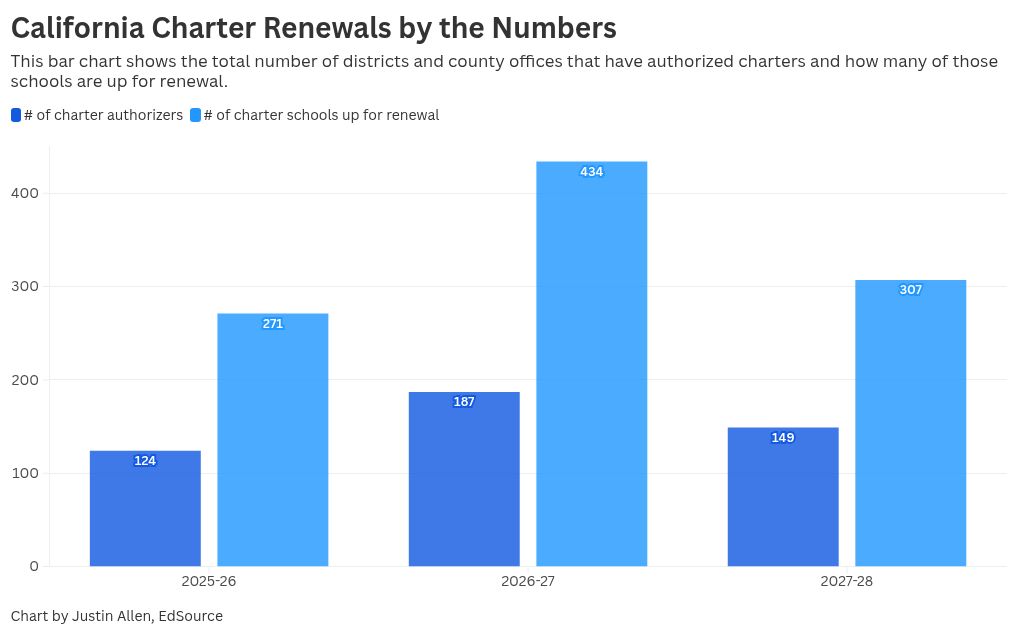
The process of charter renewal is also becoming a more significant undertaking.
With over 1,000 charter schools due for renewal in the next three years, a consequence of a pandemic-era pause, this will place considerable demands on both local school districts and county offices of education.
These rigorous renewal evaluations will scrutinize academic performance, financial health, and legal compliance, ensuring that schools continue to meet the high standards expected for the students they serve.
Enrollment Dynamics and Inter-District Competition
Historically, charter schools were often seen by large urban districts as a solution to overcrowding and the need for expanded educational options.
However, with declining statewide enrollment figures, the dynamic has shifted.
Districts are now increasingly competing with charter schools for a shrinking pool of students.
For example, the Los Angeles Unified School District (LAUSD), which once served a significantly larger student population, now sees charter schools accounting for a substantial portion of its student body, leading to considerable financial implications for the district.
This competitive environment has prompted some districts to enhance their own choice programs, such as magnet schools and independent study options, in an effort to retain and attract students.
The California Department of Education reports a significant number of students participating in independent study programs offered by districts and county offices, highlighting the growing demand for flexible learning arrangements.
While charter school enrollment continues to grow, the pace has moderated, and the rate of new school openings has also slowed.
This suggests a maturing market and a greater focus on the sustainability and quality of existing charter schools.
Sustainability and the Future of Charter Schools
The trend of declining enrollment is also impacting some established charter schools, leading to closures.
This reality prompts important questions about the long-term sustainability of the charter school model, particularly in environments with diminishing student populations.
The challenge lies in finding a balance where educational choice can thrive without compromising the overall strength and stability of the public education system.
The focus is increasingly shifting towards ensuring that all schools, both district and charter, are positioned to provide the best possible education for every student.
Organizations dedicated to supporting charter school authorizers are actively working to enhance authorizing practices amidst political and public pressure.
Their core mission remains ensuring that all charter students receive a high-quality education.
Charter schools were initially conceived as a catalyst for innovation, designed to address persistent challenges within California's education system, particularly for underserved students and those with unique needs.
While many have succeeded in this endeavor, the sector is now navigating a period of growth and maturation.
This involves finding the right equilibrium between fostering continued innovation and strengthening accountability, presenting an opportunity to refine and improve the entire public education framework for the benefit of all students in California.
Conclusion
California's charter schools are at a pivotal moment, demonstrating robust enrollment growth while simultaneously facing increased scrutiny and evolving regulatory frameworks.
The sector's ability to adapt to these changes, address concerns regarding oversight and financial accountability, and continue to innovate in serving diverse student populations will be crucial for its future.
For students, parents, educators, and policymakers, understanding the multifaceted nature of charter schools—their successes, challenges, and the ongoing policy debates—is essential for shaping the future of public education in California and beyond.
The commitment to providing quality education for all students remains the guiding principle as this dynamic sector continues to evolve.







 Explore AI Teaching Tools
Comments (0)
Please login to comment
No comments yet
Be the first to comment on this article