
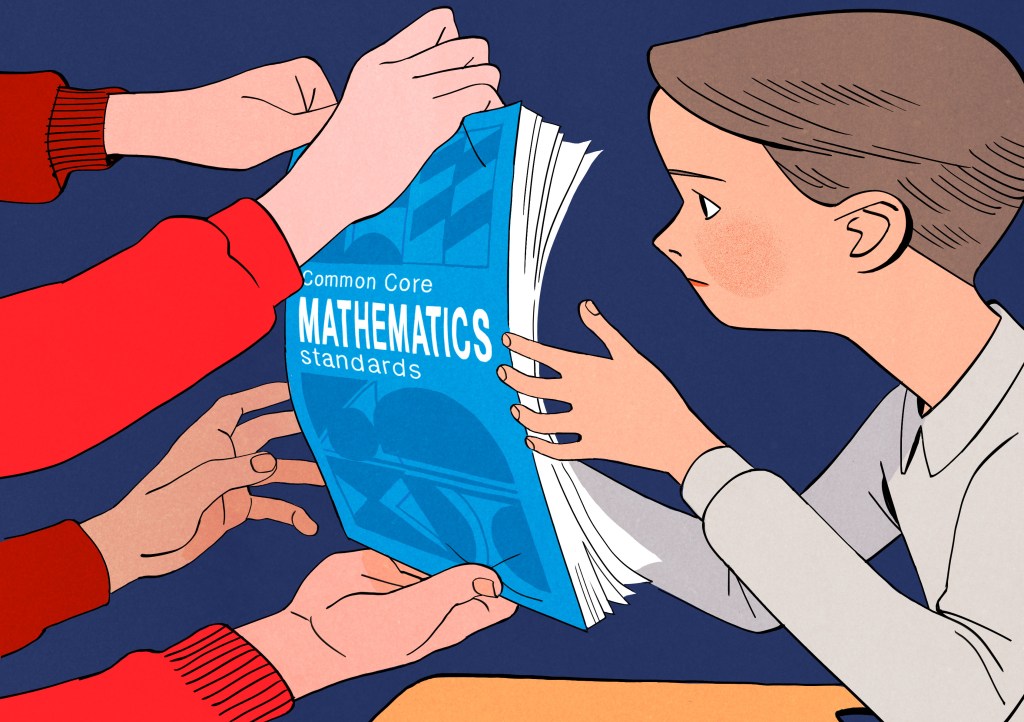
Math Wars: As Conservative Groups Target Standards, States Face a New Educational Battleground
The familiar rumble of culture wars in education has shifted its focus, moving from the contentious debates over social studies and history to the seemingly neutral territory of mathematics. This evolution signals a new front in the ongoing struggle over what and how students should learn, with profound implications for classrooms across the nation.
From Social Studies to Subtraction: A Shifting Front
For years, educational standards have been a lightning rod for debate, particularly concerning how subjects like history and civics are taught. Now, conservative organizations are turning their attention to mathematics, aiming to reshape the very foundation of math education. This strategic pivot suggests a broader agenda to influence curriculum and pedagogy at the state level.
At the heart of this new conflict are the proposed math standards in states like South Dakota. These revisions, often presented as efforts to simplify and clarify, are drawing sharp criticism from educators who fear a significant loss of depth and rigor. The debate highlights a fundamental disagreement about the purpose and structure of educational standards.
The South Dakota Showdown: Simplicity vs. Substance
In South Dakota, a proposed rewrite of the state's math standards has ignited a fierce debate. The new draft, significantly shorter than its predecessor, is championed by state education officials as a move toward greater clarity and accessibility for teachers and parents. However, many educators argue that this simplification comes at a steep price.
Susan Gilkerson, a veteran math teacher and school bus driver from the rural Oldham-Ramona-Rutland district, voiced her concerns forcefully. She described the proposed standards as so "scant" that teachers would struggle to implement them effectively. The existing standards, she explained, provide detailed guidance on both the mathematical concepts to be taught and the specific skills students need to demonstrate mastery.
"When I talk to my students, I want them to understand it," Gilkerson stated, referencing a concept like the Pythagorean theorem. She expressed worry that the new, condensed standards offer little direction on how students can prove their comprehension of this and countless other mathematical ideas.
Conversely, South Dakota's Secretary of Education, Joseph Graves, defended the proposed changes. He argued that the current standards are overly complicated and difficult for teachers and parents to grasp. "Our whole goal was to simplify, simplify, simplify," Graves asserted, aiming to make the standards more digestible.
The Archimedes Influence: A Conservative Blueprint for Math
The push for these simplified standards in South Dakota is not an isolated phenomenon. A key influence on the state's draft rewrite is a new set of model math standards produced by the National Association of Scholars (NAS), a conservative group actively involved in educational policy debates. This document, dubbed the "Archimedes Standards" after the ancient Greek mathematician, advocates for states to move away from the Common Core State Standards in math.
The NAS argues that the Common Core, introduced in 2009 with the aim of establishing consistent academic expectations across the country, has injected unnecessary complexity into math education and lacks sufficient rigor. Their proposed alternative emphasizes increased memorization of math facts and a reduction in the descriptive language used to outline grade-level knowledge.
Supporters of the existing standards counter that shortening them eliminates valuable information that teachers rely on for instructional planning. Furthermore, they question whether such a drastic simplification will demonstrably improve student math achievement. "Simpler doesn't necessarily mean more rigorous," noted Jon Star, a professor of education at Harvard's Graduate School of Education.
The Common Core Legacy: A Decade of Discontent
The Common Core State Standards, a state-led initiative developed by a bipartisan group of educators and policymakers, were initially adopted by all but five states. However, their implementation quickly sparked backlash from various political perspectives.
In more liberal states, parents expressed concern over what they perceived as an excessive focus on standardized testing associated with the Common Core. Meanwhile, in more conservative states, politicians and activists decried the standards as federal overreach, infringing upon states' traditional authority over education. The Obama administration's endorsement of the Common Core further fueled this opposition.
As the Common Core became increasingly politicized, many states began to revise, re-evaluate, or abandon the standards altogether. The NAS's release of the Archimedes Standards in June aims to accelerate this trend, encouraging more states to follow suit.
NAS's Broader Campaign: Reshaping Education's Pillars
The National Association of Scholars, a 39-year-old organization, has increasingly focused its efforts on revising state educational standards, which it views as profoundly influential documents shaping curriculum, teacher training, and textbook content.
This initiative began in 2022 with the release of model social studies standards. These standards framed concepts like liberty as an "American birthright" and characterized civics instruction promoted by mainstream organizations as a "recruitment tool of the progressive left." The NAS subsequently turned its attention to science standards in 2024 and math standards in the past year, with English language arts standards slated for 2026.
In introducing the Archimedes math standards, the NAS acknowledged that while the Common Core contained "useful elements," it was deemed insufficiently demanding and "rushed into public use without sufficient testing and evaluation." The association contends that the Archimedes standards will enhance students' mental math abilities by requiring more memorization, contrasting this with the Common Core's perceived "deemphasizing" of fundamental math facts.
Banning Calculators and Embracing "Lucidity"
A key tenet of the Archimedes Standards is the prohibition of calculator use before high school. This measure is intended to reinforce foundational arithmetic skills and encourage deeper engagement with mathematical concepts.
The overarching goal, according to the NAS, is "lucidity"—creating standards that are readily understandable by teachers and parents. To illustrate this point, the association contrasts a Common Core second-grade standard on addition and subtraction, which spans 67 words, with its own 24-word version.
The Hillsdale Connection: A Philosophical Alignment
The Archimedes Standards were authored by Jonathan Gregg, an assistant professor of education at Hillsdale College. Hillsdale, a Christian liberal arts college, has gained prominence for its conservative educational philosophy, with its president having chaired Donald Trump's 1776 Commission on "patriotic education."
Gregg, with academic backgrounds in math, English, humanities, and math education, believes his diverse expertise equipped him to craft the standards in clear, accessible prose. He argues that this simplicity empowers teachers to tailor their instruction to individual classroom needs. "You can't overprescribe. Teachers are the ones in the room, the ones facing the students," Gregg stated, emphasizing the professional judgment of educators.
He views standards as unifying principles that can garner support from students, teachers, parents, policymakers, and researchers, provided they are universally understood.
South Dakota's Embrace and the Echoes of Controversy
In South Dakota, the promise of accessibility in the Archimedes Standards resonated with Secretary of Education Joseph Graves. He described parents and teachers as being "absolutely at sea" with the state's current Common Core-aligned math standards, struggling to comprehend their meaning.
This led Graves's department to produce the significantly condensed rewrite last summer, drawing inspiration from the Archimedes document and other state standards. The state's math standards dispute has been further intensified by the NAS and Hillsdale College's involvement in a contentious update of South Dakota's social studies standards in 2022.
During that social studies review, then-Governor Kristi Noem replaced members of the standards commission with political allies and appointed a retired Hillsdale professor to oversee the rewrite. The resulting standards were approved in 2023, but drew criticism from Native American groups for omitting essential topics related to tribal history and culture, and from teachers for prioritizing memorization over inquiry.
However, the NAS lauded South Dakota's social studies rewrite for taking "a clear stand against both the discriminatory ideologies commonly referred to as Critical Race Theory and the subordination of social studies instruction to political activism."
Criticism Mounts: Educators Voice Alarm
The new math standards have similarly faced sharp criticism from teachers and university education professors. An education department survey on the math rewrite yielded 44 comments, with all but four expressing disapproval.
Gilkerson, the teacher, pointed to the revised eighth-grade standard on scientific notation. The new version explains the expectation in just 10 words, compared to the previous 53 words. While Gilkerson, with 15 years of teaching experience, understands the specific skills students need for the state test, she worries that new teachers will lack this clarity, potentially impacting test scores.
Sharon Vestal, president of the state's Council of Teachers of Mathematics and an associate professor at South Dakota State University, urged Secretary Graves to abandon the rewrite. "They're poorly written, and a lot of the math content has been lost by simplifying the language," she stated, referring to the revised standards.
Voices of Support Amidst the Opposition
Despite the widespread criticism, a few educators have expressed support for the rewrite. Susan Fairchild, a veteran math teacher at Watertown High School who served on a state committee reviewing the new standards, found the simplicity beneficial. "As a new teacher, you don't have to try and figure out what all of these fancy words mean," she said.
Monte Meyerink, another committee member and an assistant professor of math education at Northern State University, led a review of research on effective education standards to guide the department's revision process. He acknowledged that he is unaware of research directly linking the clarity of standards to student proficiency. However, he noted that simplifying standards is a growing trend, the long-term effects of which will not be understood for another 15 to 20 years.
Meyerink also mentioned that once the standards are finalized, the department plans to release an "unpacked" version with more detail. This assurance does little to comfort Vestal, who expressed concern about the quality of those unpacked standards, given the perceived deficiencies in the initial proposals.
The Debate Over Rigor and Simplification
National math education researchers also challenge the Archimedes Standards' premise that simpler standards lead to improved teaching. Michael Steele, an education researcher at Ball State University, highlighted the Common Core's fourth-grade standard for fractions, which requires students to "Explain why a fraction a/b is equivalent to a fraction (n x a)/(n x b) by using visual fraction models, with attention to how the number and size of the parts differ even though the two fractions themselves are the same size. Use this principle to recognize and generate equivalent fractions."
The Archimedes Standards version simplifies this to: "Find equivalent fractions and reduce fractions to their simplest form." Steele argued that while the Common Core standard might take a moment to decipher, it serves as a valuable reminder for teachers of how they learned fractions, thereby enhancing their ability to teach the concept effectively.
"What this group calls lucidity in many cases, I might call an oversimplification of mathematics," Steele concluded, suggesting that the pursuit of simplicity may inadvertently strip away crucial conceptual understanding.
A National Ripple Effect?
South Dakota's final vote on its math standards rewrite is scheduled after a public hearing. Meanwhile, the National Association of Scholars is actively promoting its Archimedes Standards to other states.
Jonathan Gregg, the author of the Archimedes Standards, indicated that he is advising the Louisiana Department of Education on its math standards review, which commenced last year. He anticipates that while not as direct as in South Dakota, the influence of the Archimedes community will be discernible in Louisiana's revised standards.
This movement signals a concerted effort to reshape the landscape of math education across the United States, moving beyond the era of Common Core and introducing a new set of principles that prioritize simplicity and foundational skills, while raising questions about the preservation of depth and pedagogical nuance.






 Explore AI Teaching Tools
Comments (0)
Please login to comment
No comments yet
Be the first to comment on this article