
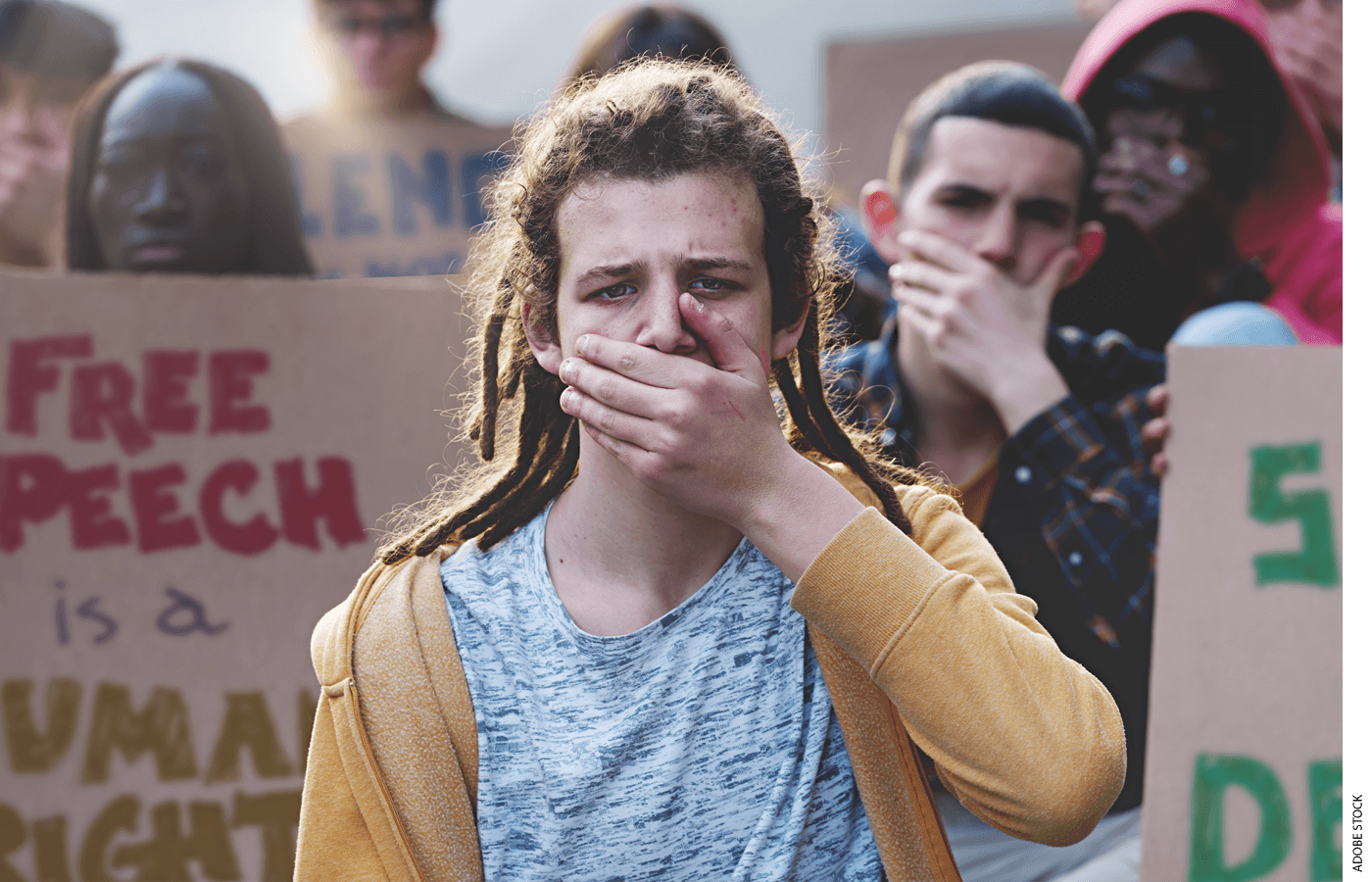
I have a t-shirt that reads, “Free Speech Makes Free People.” I received it as a donor to the Foundation for Individual Rights and Expression (FIRE). When I’ve worn it in public, I often get supportive comments—usually from men I suspect are politically conservative. As a lifelong liberal, this has sometimes made me uncomfortable. But the past few years have made one thing clear: while free speech may look Republican-coded on t-shirts, it is far from Republican-coded in practice.
Free Speech Under Pressure from Left and Right
Over the last decade, free speech has faced sustained attacks from both political camps, though in very different ways:
- From the left, restrictions have generally been bottom-up—through student activism, campus protest culture, and professional organizations enforcing shifting language norms.
- From the right, particularly under the Trump administration, restrictions have come top-down—using federal power to limit campus expression, punish dissent, and withhold funding.
In both cases, the result is the same: diminishing support for the robust free speech protections guaranteed by the Constitution.
Campus Censorship: A Firsthand View
I joined FIRE in 2020 because, as a professor at the University of Southern California, I saw hostility to free speech growing in academia. This trend—documented by Greg Lukianoff in The Coddling of the American Mind—was visible on my campus and within professional associations like the American educational research Association.
By the time I entered academia in 2006, censorship pressures were already building: narrowing acceptable language, discouraging dissenting viewpoints, and even shouting down invited speakers. I recall faculty protestors trying to silence then–Secretary of Education Arne Duncan at a national conference—his mainstream views treated as too controversial to hear.
Conservative media seized on these moments, sometimes exaggerating them, but not without reason. Universities are overwhelmingly liberal, and student- and faculty-driven activism has often created a climate of fear for those questioning progressive orthodoxy. Still, Democrats mostly ignored the issue, avoiding explicit restrictions on free speech. These were grassroots, not government-led, assaults.
The Trump Administration’s Top-Down Assault
Since returning to power, the Trump administration has taken the opposite approach: weaponizing the federal government against campus speech. Among the most notable actions:
- Seeking deportation of pro-Palestinian student protestors—punishing them for their current or future speech.
- Threatening universities with loss of tax-exempt status if they fail to suppress protest.
- Withholding federal funding from institutions accused of tolerating “too much” dissent.
- Pressuring schools to censor administrators and faculty for discussing sensitive topics like gender identity.
Public Opinion: No Safe Haven for Speech
Unfortunately, these government-led restrictions are finding little resistance. Recent national surveys show most Americans oppose student protests and support universities cracking down on speech. Republicans and older Americans are especially anti-speech, but Democrats too show ambivalence—even about simple expressions like criticizing campus leaders on social media.
This lack of public support raises a dangerous possibility: that free speech rights will continue to erode with little opposition, first targeting non-citizens but inevitably expanding to all Americans.
Free Speech as a Democratic Foundation
The principle that “free speech makes free people” is not just a slogan—it is a democratic cornerstone. When expression is restricted, whether by social pressure from the left or government action from the right, liberty itself is diminished.
Defending free speech means:
- Opposing censorship from both allies and opponents
- Protecting even uncomfortable or offensive speech
- Building coalitions across political divides to safeguard this fundamental right
The time to act is now. If we do not resist censorship consistently, the erosion of our freedom may soon become irreversible.
Morgan Polikoff is a professor of education at USC Rossier.
This essay originally appeared on morganpolikoff.com.
Original post: The Vanishing Constituency for Campus Free Speech at Education Next.
Educational content curated for learning purposes. Attribution maintained to original sources.






 Explore AI Teaching Tools
Comments (0)
Please login to comment
No comments yet
Be the first to comment on this article