
Early Childhood Divide: How Public and Private Settings Shape a Child's First Steps
The promise of early childhood education and care (ECEC) as a powerful equalizer, offering every child a fair start regardless of their background, is a widely held ideal. However, a closer look at OECD countries reveals a more complex reality. Despite rising participation rates, significant inequalities persist, and the very structure of ECEC provision, particularly the split between public and private settings, may be inadvertently widening the gap for the most vulnerable children.
The Shifting Landscape of Early Learning
Across most developed nations, the provision of ECEC is a mixed landscape, with both publicly operated centers and a variety of private entities, including non-profit and for-profit organizations, playing a role. This dual system, while expanding access, often leads to a divergence in the populations served, the geographical reach of services, and the quality of the environments offered.
The dominance of public management varies considerably. In countries like Chile, Colombia, Denmark, Finland, Israel, Spain, Sweden, and Türkiye, public institutions account for at least 60% of pre-primary settings. In stark contrast, Germany sees private providers taking the lead, while Ireland and New Zealand operate almost entirely within the private sector, with a significant portion of these being for-profit ventures.
This trend is even more pronounced for the youngest learners, those under the age of three. Data from TALIS Starting Strong surveys indicate that in nearly every participating country, the majority of infant and toddler care settings are privately managed. For-profit models are particularly prevalent in Ireland, Israel, New Brunswick and Quebec (Canada), and New Zealand, where they constitute over 40% of all provision for this age group.
Market Forces and Equity Concerns
The increasing reliance on private operators is often a response to government strategies aimed at rapidly expanding ECEC supply. However, this market-driven approach raises critical questions about equity and access for all children.
Evidence suggests a geographical and socio-economic clustering of ECEC settings. In several countries and subnational regions, public centers are more likely to be found in rural areas, smaller towns, and neighborhoods facing greater socio-economic challenges. Private settings, conversely, tend to concentrate in urban centers and more affluent communities.
This spatial disparity is deeply concerning because children from disadvantaged backgrounds—those from low-income families, with limited proficiency in the dominant language, or with special educational needs—stand to benefit the most from high-quality ECEC. Paradoxically, these are often the children who end up in settings with fewer resources and potentially less enriching learning environments, inadvertently entrenching social divides from the earliest stages of life.
Quality Gaps and Family Engagement
Data from TALIS Starting Strong highlights a concerning difference in the physical environments of public versus private ECEC centers. Leaders of public ECEC facilities frequently report poorer conditions, such as inadequate ventilation, higher noise levels, and less space, compared to their private counterparts.
In some instances, private settings are more actively engaged with families, a factor strongly linked to improved child outcomes. This proactive approach to family engagement is particularly noted in pre-primary settings in Colombia, Finland, Morocco, Norway, Spain, and Türkiye.
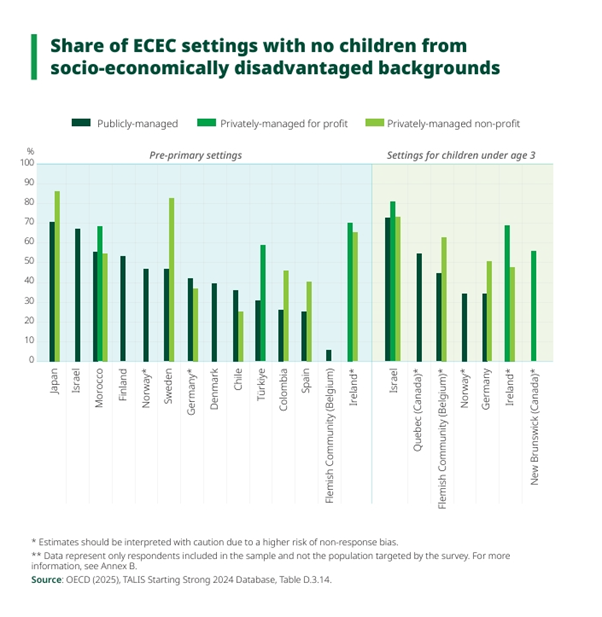
The divergence between public and private provision becomes particularly stark when examining the socio-economic composition of the children served. In Türkiye, for example, 59% of private for-profit ECEC settings report having no children from socio-economically disadvantaged homes, compared to 31% in public settings. A similar pattern emerges in Morocco, where 68% of private settings serve no disadvantaged children, versus 55% in public ones.
Interestingly, in these same countries, private providers often offer more adequate physical spaces, both indoors and outdoors, than their public counterparts. This creates a complex picture where disadvantaged children might be physically better accommodated in some private settings but are less likely to be present in those settings at all.
Navigating the Mixed Market
While the divide is evident in many regions, there are notable exceptions where public and private provision appears more aligned. In the Flemish Community of Belgium, for both under-3 and pre-primary age groups, private for-profit settings exhibit similar characteristics to public ones. Similarly, in Norway, private for-profit settings for under-3s, and in Germany and Quebec (Canada) for under-3s, the distribution and certain quality aspects of public and private provision are remarkably similar.
Furthermore, in the Flemish Community of Belgium and Germany, the proportion of vulnerable children is broadly consistent across public and private settings at both ECEC levels. These examples offer valuable insights into how a more equitable mixed-market system can be cultivated.
Policy Levers for a Stronger Future
Governments face a delicate balancing act. While private provision is crucial for expanding supply and increasing overall participation, without careful policy design, it risks exacerbating existing inequalities. Public ECEC centers, often serving the most complex needs, require adequate resources to thrive.
Investing in Public Infrastructure
A primary recommendation is for governments to significantly invest in public ECEC settings. This investment should focus on equipping these centers to effectively meet the diverse needs of all populations, with a particular emphasis on vulnerable children. This includes allocating additional staff, providing enhanced professional development opportunities, and ensuring access to necessary materials for settings serving a high proportion of disadvantaged children, where the impact of such investments is often greatest.
Oversight and Accountability for Private Providers
Simultaneously, private providers, many of whom receive substantial public funding, require robust oversight. This is already being implemented in some areas at the pre-primary level, where privately managed settings are more frequently subjected to external inspections, including financial audits, than their public counterparts.
In countries like Türkiye, Spain, and Finland, private settings are also subject to stricter checks on structural quality and adherence to established standards. Funding mechanisms should be directly linked to stringent quality benchmarks and transparent reporting requirements, ensuring that public funds designated for education are not diverted to shareholder profits.
Incentivizing Inclusion
To foster greater equity in mixed-market ECEC systems, governments should actively incentivize inclusion. This could involve offering subsidies or tax breaks for disadvantaged children enrolled in private ECEC settings. Alternatively, public funding for private providers could be made conditional on their commitment to operating in less affluent areas or serving a diverse student population.
These targeted measures are essential for preventing the deepening of inequality in markets where both public and private ECEC provision coexist. High-quality ECEC represents a cost-effective strategy for reducing long-term spending on remedial education and social support services.
Achieving this vision requires strong governance frameworks and intelligent, strategic investment. Without decisive action, the fundamental promise of ECEC as a leveler of the playing field will remain an aspiration rather than a reality for countless children.






 Explore AI Teaching Tools
Comments (0)
Please login to comment
No comments yet
Be the first to comment on this article