
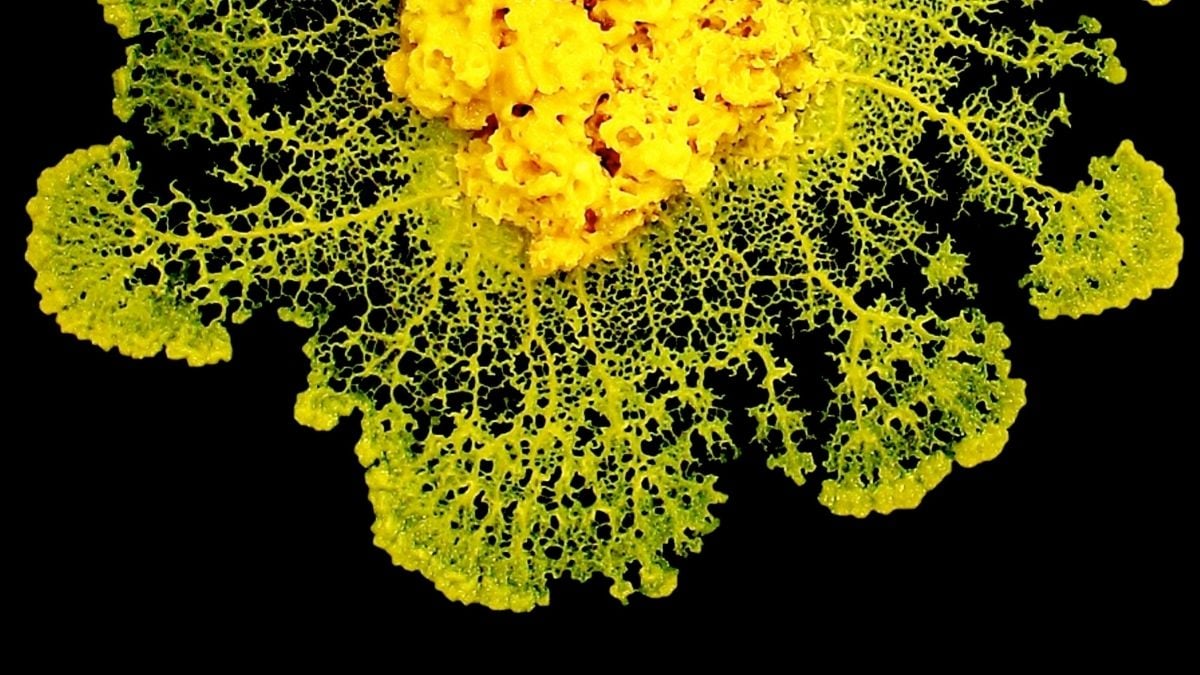
Imagine a single-celled organism, a blob of goo, that can navigate complex mazes and find the most efficient path to food sources. This isn't science fiction; it's the reality of slime mold, and recent discoveries about its decision-making processes are sending ripples through the scientific community. What if understanding how these seemingly simple life forms operate could fundamentally change how we approach complex problem-solving in education, particularly in fostering critical thinking and adaptive learning strategies in our students?
The Unseen Intelligence of Slime Mold
For decades, scientists have been captivated by the peculiar behaviors of slime mold, specifically species like *Physarum polycephalum*. These organisms, lacking any centralized nervous system or brain, exhibit remarkable problem-solving abilities. When presented with multiple food sources, they don't just randomly explore; they intelligently connect these sources, often forming networks that mirror efficient transportation systems.
This ability to "decide" on optimal paths without a brain has led researchers to delve deeper into the underlying mechanisms. It suggests a distributed intelligence, where simple local interactions can lead to sophisticated global outcomes. This challenges our traditional understanding of intelligence and decision-making, which is often tied to complex neurological structures.
"We're seeing complex behaviors emerge from incredibly simple rules," notes Dr. Anya Sharma, a leading researcher in computational biology. "It's a powerful reminder that 'intelligence' can manifest in forms we haven't traditionally recognized."
The implications for education are profound. If such complex decision-making can arise from simple, interconnected components, what does this mean for how we design learning environments and curricula? It encourages us to look beyond rote memorization and embrace approaches that foster emergent understanding and adaptive problem-solving.
Rethinking Learning Through a Slime Mold Lens
The way slime mold operates offers a compelling metaphor for how students can learn and adapt. Instead of expecting students to possess innate, fully formed problem-solving skills, we can cultivate them by providing the right environmental conditions and simple, guiding principles. This shift in perspective can transform how educators approach instruction and assessment.
Consider the process of learning itself. Students often start with fragmented pieces of information and gradually connect them to form a coherent understanding. This mirrors the slime mold's exploration and connection-building process. The goal for educators, then, becomes facilitating these connections and encouraging exploration within a structured yet flexible framework.
Fostering Adaptive Problem-Solving
One of the key takeaways from slime mold research is its ability to adapt to changing environments. When a food source disappears or a new obstacle is introduced, the slime mold can reconfigure its network. This resilience and adaptability are crucial skills for students navigating an ever-changing world.
Educators can foster this by:
- Presenting students with open-ended problems that have multiple potential solutions.
- Encouraging experimentation and iteration, where mistakes are viewed as learning opportunities.
- Designing activities that require students to connect disparate concepts and information.
- Utilizing tools that allow for flexible exploration and discovery.
This approach moves away from a one-size-fits-all model of instruction towards a more dynamic and student-centered experience. It's about empowering students to become active participants in their learning journey, much like the slime mold actively seeks out and optimizes its environment.
Leveraging Simple Tools for Complex Outcomes
The slime mold's intelligence emerges from simple, decentralized interactions. This suggests that we don't always need overly complex pedagogical tools to achieve sophisticated learning outcomes. Sometimes, the most effective approaches are those that are intuitive, engaging, and facilitate connection.
For instance, educators can use tools that encourage collaboration and peer-to-peer learning. When students work together, they create a network of ideas and perspectives, similar to the slime mold's interconnected network. This collaborative environment can foster deeper understanding and more creative solutions.
"The beauty of slime mold is its simplicity," says Dr. Kenji Tanaka, a physicist studying emergent behavior. "It demonstrates that complex, intelligent-like behavior can arise from fundamental, almost elemental, processes."
Platforms that offer interactive elements and opportunities for real-time engagement can be particularly effective. These tools can help break down complex topics into manageable parts, allowing students to explore and connect them at their own pace. The focus is on building understanding through active participation rather than passive reception of information.
The Power of Playful Learning
The concept of "makes decisions" without a brain also highlights the power of intrinsic motivation and exploration. Slime mold isn't "forced" to find food; it's driven by its internal mechanisms and environmental cues. This can be a powerful model for engaging students.
Incorporating elements of play and gamification into the classroom can tap into this intrinsic drive. Think about how a well-designed MentofyCove classroom game can make complex concepts accessible and fun. Activities like a trivia game or a word search game can encourage exploration and reinforce learning in a low-stakes, engaging manner.
Furthermore, smart student grouping, like that offered by MentofyGroups, can create environments where diverse ideas collide and connect, mimicking the slime mold's network formation. These tools can help educators orchestrate collaborative learning experiences that are both effective and engaging.
Empowering Educators with Adaptive Tools
The discoveries surrounding slime mold offer a compelling narrative for educators: intelligence and effective decision-making can be cultivated through structured exploration and interconnectedness, not just through innate ability or complex systems. This perspective shift is vital for modern pedagogy.
Educators can start by embracing tools that support dynamic lesson planning and interactive teaching. Platforms like Mentofy AI teaching tools can assist in creating engaging materials and assessments, freeing up valuable time for educators to focus on facilitating student connections and deeper understanding. Features such as AI lesson plan generation and an exam creator can streamline preparation, allowing for more focus on the "how" of learning.
The ability to analyze student progress and adapt instruction is also key. Tools that offer insights into student engagement and understanding, perhaps through interactive widgets on an interactive board like MentofyBoards, can help educators respond to individual and group needs in real-time. This adaptive approach mirrors the slime mold's ability to reconfigure itself in response to its environment.
Ultimately, the slime mold's silent, decentralized intelligence is a powerful reminder that effective learning is often about building connections, fostering exploration, and adapting to new information. By embracing these principles and leveraging the right tools, educators can cultivate resilient, adaptive thinkers ready to tackle the challenges of tomorrow.






 Explore AI Teaching Tools
Comments (0)
Please login to comment
No comments yet
Be the first to comment on this article