
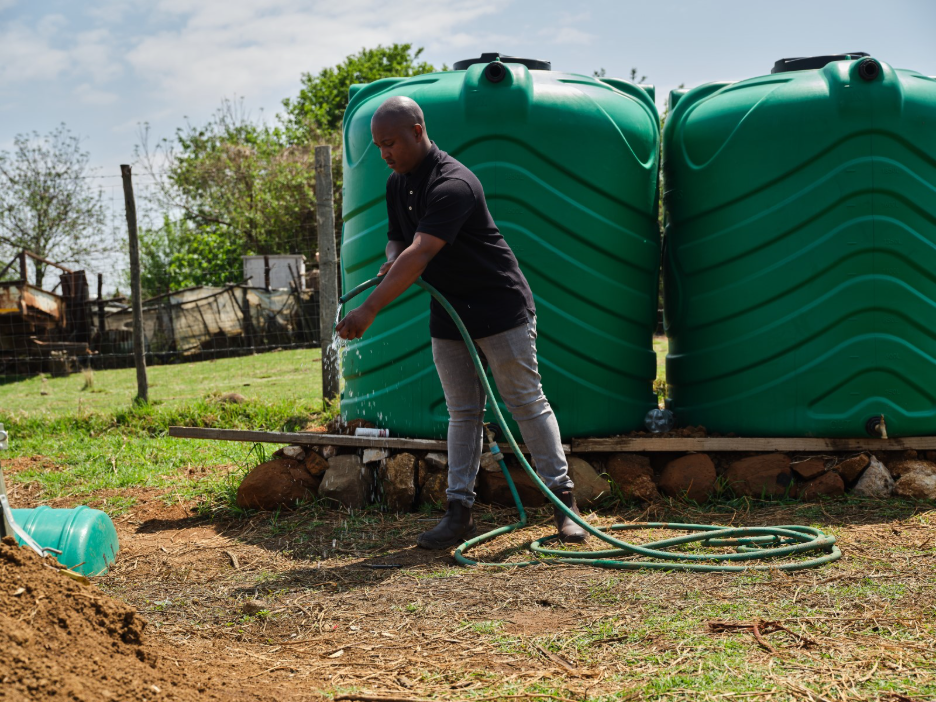
From Jazz Stage to Biogas Pioneer: South African Entrepreneur Ignites Rural Energy Revolution
Just five years ago, the world grappled with an unprecedented global health crisis, a period that brought cities to a standstill and led to widespread job losses. For Thabo Mngomezulu, a seasoned jazz vocalist in South Africa, this era marked a profound personal turning point. The silence that fell upon the music scene left him searching for a new purpose, a new avenue to channel his energy and drive.
“It was a profoundly disorienting time,” Mngomezulu reflects. “I felt adrift, unsure of my next steps. But I knew, with absolute certainty, that I needed to pivot beyond music.” This pivotal moment of introspection would ultimately lead him down an unexpected, yet deeply impactful, path: harnessing the power of organic waste to combat energy poverty in the heart of rural South Africa.
The Unseen Waste of Progress
Mngomezulu’s journey into the world of sustainable energy began not in a laboratory or a boardroom, but on the very land where he grew up. His childhood memories are steeped in the rhythms of agricultural life, working alongside his grandmother on their family farm.
“During the planting seasons, I was struck by the sheer volume of organic material we generated,” he explains. “It was a constant stream of byproducts, and I found myself asking, ‘What can we possibly do with all of this?’” This early observation planted a seed that would later blossom into a groundbreaking solution.
The challenges Mngomezulu witnessed on the farm are emblematic of broader issues plaguing many rural communities across South Africa and beyond. Long before the pandemic, deep-seated inequalities, including stark income disparities, unequal access to opportunities, and significant regional imbalances, were already defining the landscape.
One of the most persistent and damaging of these inequalities is energy poverty. This lack of access to reliable and clean energy sources for essential needs like cooking and heating disproportionately affects millions, particularly in Sub-Saharan Africa. Astonishingly, a staggering 65% of the population in this region lacks basic electricity access.
The consequences are dire. Many households are forced to rely on open-fire cookstoves, a practice that not only contributes to indoor air pollution but also poses severe health risks. Globally, approximately 700 million people in Sub-Saharan Africa depend on traditional biomass – such as fuelwood, charcoal, and agricultural residues – for their energy needs.
The health toll is devastating. Exposure to smoke from burning biomass is linked to an estimated 600,000 premature deaths annually, a grim statistic that underscores the urgent need for cleaner alternatives.
From Farm Waste to Fuel: The Kasi Gas Solution
It is against this backdrop of urgent need that Mngomezulu’s startup, Kasi Gas, emerged. The company is pioneering a transformative approach, converting readily available organic waste into a clean, affordable source of biogas for cooking and heating.
The science behind biogas is elegant in its simplicity. While biomass refers to the raw organic material itself – think crop stalks, animal manure, or food scraps – biogas is the combustible gas, primarily methane, produced when these materials decompose in an oxygen-free environment. This process, known as anaerobic digestion, is driven by naturally occurring bacteria.
By capturing methane that would otherwise be released into the atmosphere from sources like landfills and manure lagoons, Kasi Gas not only provides a valuable energy resource but also actively mitigates harmful greenhouse gas emissions. This dual benefit positions the startup as a powerful force for both environmental and social good.
The impact extends beyond energy provision. The byproduct of the biogas production process is a nutrient-rich digestate, a potent natural fertilizer. This valuable resource can be used to revitalize depleted soils, offering a lifeline to small-scale and subsistence farmers who are often on the front lines of food insecurity.
Kasi Gas is strategically rooted in a rural South African community, with a clear mission to serve low-income areas across the country that are most acutely affected by energy poverty and a lack of waste management infrastructure.
“In many of these areas, formal waste management services are virtually non-existent,” Mngomezulu explains. “We step in to harness this organic waste, collecting it from a diverse range of sources including restaurants, schools, and numerous households. This collected material is then processed at our facility, and we deliver the resulting biogas and fertilizer directly to our consumers.”
This localized, circular economy model ensures that waste is not a burden but a valuable resource, creating a tangible benefit for both the environment and the community.
Navigating the Entrepreneurial Wilderness
Transforming a compelling idea into a functioning startup is rarely a smooth journey, and Mngomezulu’s experience was no exception. The path from concept to reality was paved with considerable trial and error.
Fortunately, he found a crucial ally in a business partner with over two decades of experience in the industry. This mentorship provided invaluable guidance, preventing him from venturing into the complex world of entrepreneurship entirely unprepared.
Despite this support, Mngomezulu faced significant hurdles, particularly in securing the necessary investment to launch his venture. The challenge was amplified by the absence of a tangible prototype to demonstrate the viability of his innovative concept, leaving him in a precarious position.
His persistent search for support eventually led him to a pivotal opportunity: the Mercedes-Benz Fellowship, known as beVisioneers. This global program is designed to empower young innovators, aged 16 to 28, by equipping them with the essential training, mentorship, and resources needed to launch and scale environmentally positive projects.
Funded by philanthropic contributions from Mercedes-Benz and administered by the non-profit organization The DO School Fellowships, beVisioneers has fostered thousands of changemakers across 55 countries. Mngomezulu proudly stands among them.
“The beVisioneers fellowship was absolutely critical for me,” he states. “They provided the validation my idea desperately needed, saying, ‘This is a great business.’ They meticulously reviewed my progress and then provided the crucial funding to develop a prototype.”
With a working prototype in hand, Mngomezulu could finally demonstrate the efficacy of his biogas system to local organizations in South Africa. This tangible proof of concept opened doors, leading to the acceptance of his subsequent applications and paving the way for further growth.
A Symphony of Innovation and Impact
The validation and support garnered through the beVisioneers program have been instrumental in the expansion of Kasi Gas. The startup has recently achieved significant recognition, being named a finalist in the 2026 Global Cleantech Innovation Programme – South Africa. This prestigious initiative is a collaborative effort by the United Nations Industrial Development Organization (UNIDO) and the Global Environment Facility.
It is truly remarkable that this impactful venture originated from the vision of a former jazz musician. Mngomezulu’s story is a powerful testament to how passion, conviction, and access to international exposure through programs like beVisioneers can ignite a transformative startup.
Today, Mngomezulu continues to embrace his musical roots, occasionally taking on performance bookings as a cherished side pursuit. However, his primary focus has decisively shifted to his role as an entrepreneur, dedicated to alleviating energy poverty and supporting agricultural communities in rural South Africa.
Looking ahead, Mngomezulu harbors ambitious plans to expand Kasi Gas’s reach. He envisions owning and operating at least three to five company plants, ultimately aiming to establish a micro-franchise network that spans across rural South Africa. Each step, he emphasizes, is being taken with careful consideration and a grounded approach, one day at a time.





 Explore AI Teaching Tools
Comments (0)
Please login to comment
No comments yet
Be the first to comment on this article