
California Middle Schools: The Front Lines of the AI Revolution in Education
In the bustling classrooms of California's middle schools, a quiet revolution is underway. Artificial intelligence, once a concept confined to science fiction, is now a tangible tool being tested and integrated into the daily lives of students and teachers. This shift is not without its complexities, sparking both excitement and apprehension as educators navigate the uncharted territory of AI in learning.
AI as Tutor and Grader: A New Paradigm
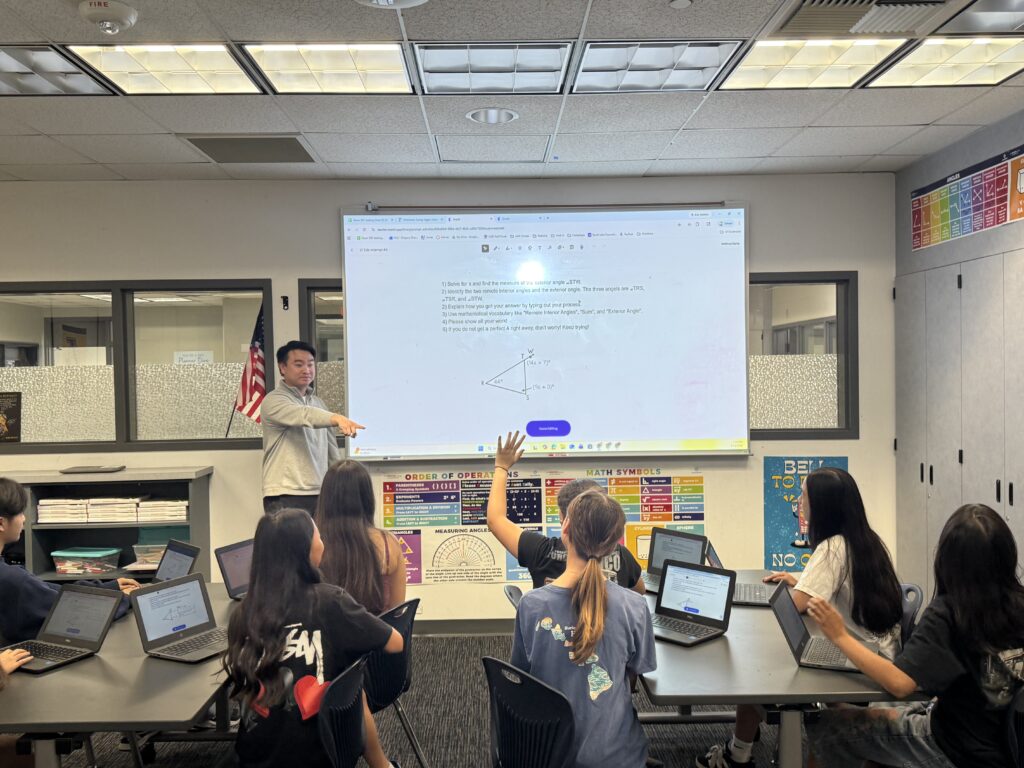
Imagine a math class where the exit ticket isn't handed to the teacher, but to a sophisticated AI program. This is the reality for eighth graders in Gregory Dharman's class at South Lake Middle School in Irvine. The AI software, Snorkl, acts as an instant grader for quizzes, exams, and homework.
Students engage with Snorkl by typing or speaking their answers. The program then provides immediate feedback, allowing students to retake assessments until they achieve an acceptable score. This approach aims to foster a growth mindset, encouraging persistence and mastery.
Dharman, a five-year veteran teacher of mathematics, robotics, and computer applications, has been actively involved in AI training through the Irvine Unified School District for the past three years. He previously served as an educational technology mentor, participating in quarterly sessions where teachers explored various AI tools and learned to leverage them for generating diverse solutions.
A significant part of this training involved equipping teachers with AI detection tools, such as Turnitin and Scribbr, to combat academic dishonesty. The emphasis, however, was on guiding students to use AI as a supplementary learning aid, not a replacement for their own cognitive efforts.
“When it comes to teaching the kids how to use AI, it’s like ‘How can I maximize this thing and use it to my advantage?’” Dharman explained, highlighting the proactive approach to AI integration.
While Dharman primarily assigns handwritten work, his students embrace the digital realm about once a month. During these sessions, the classroom buzzes with the sound of keyboards as students interact with Snorkl. They can even prompt the AI to act as a tutor, requesting step-by-step guidance on complex problems.
Snorkl's grading criteria are based on the content Dharman uploads, though he retains the flexibility to adjust parameters. He values Snorkl for its ability to push students to articulate their thought processes and for the personalized feedback it offers.
“In the future, AI is going to be able to personalize a lot more in terms of education or curriculum toward a specific student, or a specific topic that a student needs,” Dharman mused, underscoring the potential for hyper-personalized learning.
However, the system isn't infallible. Dharman recounted an instance where a student was unfairly penalized for rephrasing an answer, despite its correctness. This highlights the ongoing need for human oversight, as Dharman himself reviews exit tickets to ensure accuracy and fairness.
“The more AI evolves and the longer it’s around, the more teachers are willing to be able to introduce it into their classrooms, because it’s an inevitable thing that these kids are going to come across,” Dharman stated, acknowledging the pervasive nature of AI.
Navigating the AI Divide: Mixed Reactions Emerge
Across town at Marina Middle School in San Francisco, veteran teacher Matthew Helmenstine is taking a more measured approach. Helmenstine, who teaches eighth-grade social studies and journalism and boasts 25 years of teaching experience across international settings, opts to introduce AI later in the academic year.
At Marina, school-issued Chromebooks are equipped with software that blocks AI access. However, the limited number of devices means students often resort to their personal phones for digital assignments. It's on these devices that Helmenstine eventually allows his students to experiment with AI.
He has observed a spectrum of reactions from his students upon their introduction to AI. In one instance, a history video about the Mexican-American War, revealed to be AI-generated, elicited strong negative responses. “They lost their minds immediately,” Helmenstine recalled. “They’re like ‘That’s AI, that’s baloney! That’s garbage! Look at that, that’s horrible!’ They were so angry that it was AI, and I had no idea that they were against it.”
Yet, a stark contrast emerged during a schoolwide Chinese New Year assembly. An AI-animated video created by the multimedia teacher, depicting students riding horses, was met with enthusiastic approval. This juxtaposition of reactions left Helmenstine intrigued, suggesting a nuanced student perception of AI-generated content.
When the topic of tools like ChatGPT arises in class, Helmenstine's students tend to shy away, treating it as a sensitive subject. He believes this apprehension stems from a lack of familiarity with AI language models, contrasting with their more positive reception of AI-generated art.
While Helmenstine has not yet received formal AI training from the San Francisco Unified School District, this is poised to change. A recent announcement from Marina's principal indicated that AI integration is imminent, prompting teachers to consider its role in their pedagogy.
“To a lot of us that have been doing this [teaching] for a while, it’s kind of scary because we don’t know if it’s going to get away from us,” Helmenstine admitted, expressing concerns about maintaining control and fostering essential student skills.
His primary worry revolves around the potential impact on students' ability to develop vocabulary and express themselves effectively, particularly if they become overly reliant on AI for tasks like essay writing. “The greatest fear is, will students be able to develop vocabulary and express themselves if they’re relying on AI to write essays or poems, or whatever it might be? And is that going to reduce their intelligence?” he questioned.
The Challenge of Academic Integrity in the Age of AI
The rise of AI has also brought to the forefront the persistent challenge of academic integrity. Xilong “Benson” Li, a seventh and eighth-grade social studies teacher at Marina Middle School with two years of teaching experience, has witnessed an uptick in students submitting AI-generated work as their own.
Li can readily identify AI-generated content due to its distinct style, which often differs significantly from his students' previous writing or even that of their parents. “It is so different from their previous writings, or from their parents’ writings. It is just so far above, or so nonhuman, that it’s easy for me to figure out,” he stated.
In the absence of official school policies on AI, Li enforces his own disciplinary measures. His approach is consistent: a 15% deduction for unsubmitted work, but a zero for any assignment he identifies as AI-generated. “Honestly, policy is quite lax. I give 15% even if they don’t turn anything in. But if it’s AI-generated and I can tell, then I just give them a zero for it,” he explained.
Li acknowledges that students are already interacting with AI outside of school. To illustrate its capabilities, he once used ChatGPT to generate an essay answering the classic question, "Why did the chicken cross the road?" His students were captivated by the speed and efficiency of the AI's response.
“AI is a helpful tool for students. But it’s too much of a crutch if they just use it verbatim word-for-word, or copy it and pass it off as their own,” Li cautioned, emphasizing the fine line between utilizing AI as a tool and relying on it excessively.
District-Level Strategies: Building a Framework for AI Integration
While individual teachers are forging their own paths in navigating AI, school districts are beginning to implement more structured approaches. Jennie Dougherty, director of strategic initiatives at KIPP Public Schools Northern California, has dedicated 19 years to education, with 12 of those at KIPP.
Dougherty oversees the pilot testing of new AI tools, closely examining their impact on select groups of teachers and students. “We use the micro-pilot to ask questions like: Are students more confused than before? Is the teacher spending more time managing the tech than teaching? Are the kids who were already struggling falling further behind?” she outlined, emphasizing a data-driven approach to AI adoption.
“If the answer to any of those was yes, we stop,” Dougherty affirmed, demonstrating a commitment to student well-being over rapid technological adoption.
When Dougherty introduced an AI writing feedback tool called Coursemojo to middle schoolers, she anticipated a positive reception. Instead, the immediate and rapid-fire feedback from the AI overwhelmed some students, leading to distress. One student famously exclaimed, “I’m gonna crash out!”
Dougherty initially struggled to comprehend this reaction until she realized the emotional impact of receiving multiple rounds of criticism simultaneously. “Humans process feedback at the speed of emotion,” she explained, recognizing that for these developing students, the feedback felt like a barrage of judgment, undermining their confidence.
The observing teacher noted the students' difficulty in processing the rapid feedback. To mitigate this, the teacher reframed feedback not as failure, but as an integral part of the learning process. Dougherty stressed that middle school students are still forming their academic identities.
She advocates for comprehensive teacher preparation before introducing AI into classrooms, focusing on how to manage students' emotional and academic responses. “Our goal is not to introduce AI early. Our goal is to introduce agency early,” Dougherty declared.
“Because a measure of our success is not whether students can use AI. It is whether they emerge from our schools knowing who they are, and trusting themselves to navigate whatever comes next,” she concluded, articulating a vision for AI integration that prioritizes student self-efficacy and resilience.






 Explore AI Teaching Tools
Comments (0)
Please login to comment
No comments yet
Be the first to comment on this article